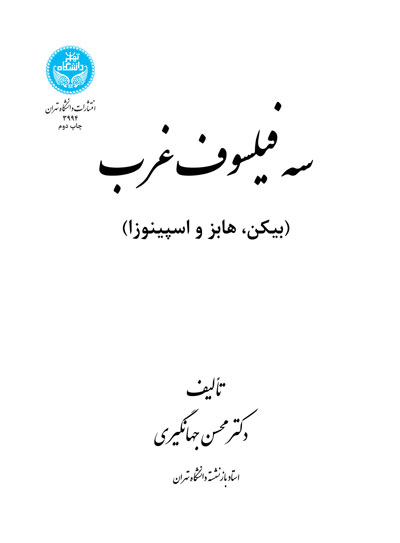
The book “Three Western Philosophers: Bacon, Hobbes, Spinoza” by Mohsen Jahangiri is a comprehensive and thoughtful study of three prominent seventeenth-century thinkers, each of whom played a decisive role in establishing modern philosophy. The author analytically explains the views and thoughts of Francis Bacon, Thomas Hobbes, and Baruch Spinoza by utilizing primary sources; these three philosophers respectively transformed European modern thought in the realms of science, politics, and metaphysics. Francis Bacon, the first figure discussed, critiques mental structures and prejudices called “idols” that obscure human cognition and proposes a new approach to scientific knowledge. Instead of traditional syllogistic reasoning, he defends an inductive method based on observation, experience, and gathering detailed data to reach general conclusions. Bacon’s methodological reform aims at useful and effective knowledge to improve human life by mastering and serving nature, thus being the pioneer of empirical science and the father of the modern scientific method. Following Bacon, Jahangiri turns to Thomas Hobbes, who, amidst the seventeenth-century English political turmoil, advanced an original theory on the origin of state and political power. Hobbes views human life in the natural state as fear and insecurity, describing it as a “war of all against all.” Liberation from this condition comes through a social contract and the transfer of absolute power to a sovereign who can establish peace and security. Hobbes’ important work, “Leviathan,” is a rational defense of absolute government grounded not in divine authority but in the collective will of citizens. Hobbes thus frees politics from theology’s dominance and moves it to the realm of reason and contract. The book’s third philosopher is Baruch Spinoza, a Jewish thinker who developed his monistic philosophy within the Cartesian rationalist tradition but went beyond it. In his magnum opus, “Ethics,” Spinoza offers a new vision of the world and humanity using a geometric style based on concepts such as substance, cause, and necessity. In his system, God and nature are one, and everything is an expression of a single substance. Human freedom is not independent will but is found in understanding the causes that necessitate conduct. Rejecting free will, Spinoza grounds ethics not on choice but on knowledge and rationality, proposing liberation through comprehension of the essential structure of existence instead of promoting asceticism or obedience. Mohsen Jahangiri, with a comparative perspective, shows how these three philosophers each in their domain laid the foundations for moving beyond scholastic philosophy into the modern world. Bacon established the empirical method, Hobbes secularized political theory, and Spinoza presented a unified system of world and human understanding, collectively building the three pillars of modern reason. Studying this book is not only beneficial for those interested in the history of Western philosophy and thought but also provides insight into the roots and crises of modern rationality.





Reviews
Clear filtersThere are no reviews yet.