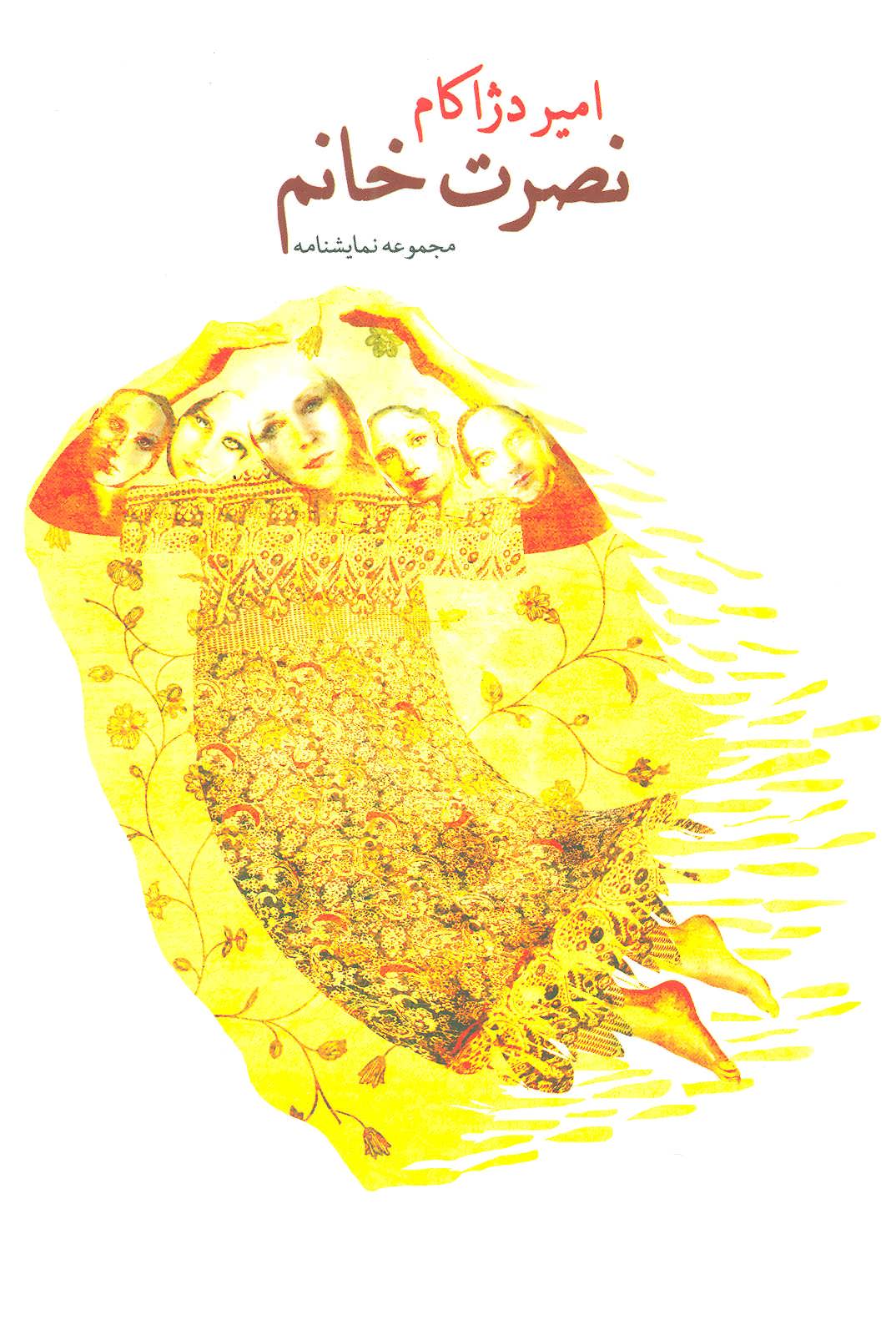
The play collection “Nosrat Khanom” includes four short plays by Amir Dezhakam, which can be considered as four perspectives on some significant and sensitive social issues that are, in a way, being forgotten, all compiled in Dezhakam’s bitter and straightforward language. “Nosrat Khanom” initially presents the play “The Imitation Assembly” to its audience. A character-rich play set in a critical context, addressing the general indifference of the younger generation toward the older generation of society and their concerns. Throughout this play, Dezhakam casts a sharp look at the fading traditions and ancient beliefs of Iranian society, criticizing their dissolution within the structure of modern life. Meanwhile, by incorporating humor, he attempts to control the bitterness in his narration through this medium. Furthermore, the combination of modern humorous expression with some symbols of ancient Iranian culture and thought—most notably the poetry of Hafez—in this play illustrates the author’s effort to depict this cultural conflict. The second play, “The Charm of Chingiz,” is a poetic narrative of the author’s encounter, embodied in a character, with Rumi from childhood to the present. It begins with the narrator’s confrontation with the “Divan-e Kabir” in the city of Kerman and an attempt to purchase it, while throughout the play, changes and transformations in the narrator’s spiritual and intellectual state are dramatically portrayed with reference to verses from the “Divan-e Kabir.” The third play, “The Infidel Wind,” is a story set amidst love and war. The author narrates a love story against the backdrop of the imposed war (Iran-Iraq War). It tells the tale of two brothers who, to win the affection of their beloved, travel to Khorramshahr on the eve of war, during which the beloved dies on the way to the battlefield, leaving the brothers with two choices. The final play, “Brief Escape,” is based on the novel “Flight of Icarus” by Raymond Queneau, translated by Kaveh Seyed Hosseini, and represents a free adaptation of the work. Overall, Dezhakam’s national and religious concerns and the search for their lost foundations or emphasis on their steadfastness form the main pillars of these plays. His insistence on employing Islamic-Iranian elements and attempting to portray the Iranian-Islamic human being through words and movements on stage has created a work that, despite comprising four short plays, could produce memorable and thought-provoking moments when performed or reinterpreted.




Reviews
Clear filtersThere are no reviews yet.