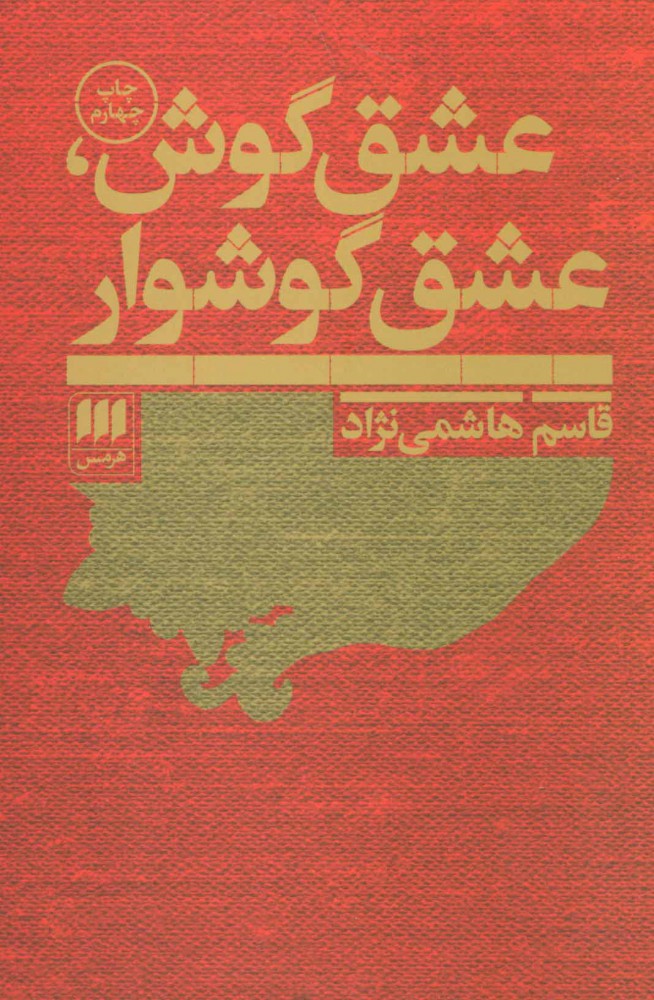
Ghasem Hashemi-Nejad was well-versed in modern literature and had profound studies in the fields of mysticism and Iranian culture. The book *Eshgh-e Goush, Eshgh-e Goushvar* (The Love of the Ear, The Love of the Earring) reflects Hashemi-Nejad’s concerns regarding mysticism and Iranian culture. The title of the book is derived from Rumi’s *Masnavi Ma’navi*: *”For a believer, this sorrow is insignificant / Value the love of the ear as much as the love of the earring.”* The author’s purpose in choosing this title is to highlight the idea that one should love the ear and the earring equally. Hashemi-Nejad believed that love and devotion to Iranian culture (the ear) emerge alongside its manifestations (the earring). Based on this, the author explores various aspects of Iranian culture in *Eshgh-e Goush, Eshgh-e Goushvar*. The book comprises seven essays connected by the thread of Iranian culture. It is divided into two sections: the first section contains three essays, and the second section has four. In the first essay titled “A Historical Perspective on Narrative: A Review,” the writer examines the development and historical trajectory of narrative within Persian culture. In this essay, Hashemi-Nejad offers suggestions for researchers interested in investigating the historical evolution of narrative in Persian culture. The second essay, titled “The Search to Rediscover the Sources of Drama in Iran,” serves as a detailed prelude to a research project on the sources of drama in Iran which was never written. In this essay, the author proposes the term “gesture” to replace “movements and postures” and examines the historical evolution of gesture in Persian literature. The third essay, “A Typological Study of Iranian Characters,” is based on the book *Mera’at al-Bolaha*, a work from 150 years ago referred to as a lexicon of colloquial expressions and terms. The author approaches this book from a new perspective in this essay. The second section of the book begins with the essay “The Language of Prayer,” in which the author delves into the mystic Hallaj, discussing prayer and the language of devotion while introducing a piece of prayer attributed to Hallaj. Hashemi-Nejad stays within the mystical realm in the next essay, “The Art of Being a Mystic.” Questions such as “Who is a mystic?” and “What are the characteristics of a mystic?” are addressed as the writer endeavors to provide answers. The essay “Facing Death” explores death through the lens of religious beliefs and Iranian eschatology, revealing how the visage of death is reflected in Persian literature. The final essay of *Eshgh-e Goush, Eshgh-e Goushvar* is somewhat unrelated to the other essays and is titled “Four Memories Brought by the Wind as Narrated by the King of Fairies.” However, it also has a secondary title that reveals its theme: *“Remembering Certain People.”* Ghasem Hashemi-Nejad was an influential figure in Iranian literature, and with his profound and extensive knowledge, he ventured into various fields. Many of his studies open new horizons for researchers and serious readers of Persian culture and literature.




Reviews
Clear filtersThere are no reviews yet.